There’s a reason earth tones keep coming back. They work. Not in a “safe and forgettable” way — in a “this room feels like it was meant to exist” way. And in 2026, the earth tone palette has evolved into something designers are genuinely excited about: warmer, richer, more intentional than the beige years that came before it.
The three colors leading the charge right now are terracotta, chocolate brown, and dark green. Each one is strong on its own. Together, with a little strategy, they create rooms that feel expensive, grounded, and genuinely alive.
Here’s how to work with them.
Why These Three Colors Work Together
Before getting into the how, it helps to understand the why.
Terracotta, chocolate brown, and dark green are all pulled from the same natural reference — the world outside. Terracotta is the clay underfoot. Chocolate brown is the rich dark soil. Dark green is the leaf, the forest, the lawn in shadow. They’re colors that exist together in nature constantly, which is why our eyes accept them as a cohesive group without having to be told.
Technically, they also play well together because of their tonal qualities. All three sit in the mid-to-dark value range (meaning none are very light or very dark at their extremes), so they have a natural weight that balances. And all three are heavily saturated with yellow or red undertones, which prevents the cold clashes you sometimes get mixing warm and cool tones carelessly.
You can use all three in one room, or you can pick one as a dominant color and let the others appear as accents. Both approaches work.
Using Terracotta
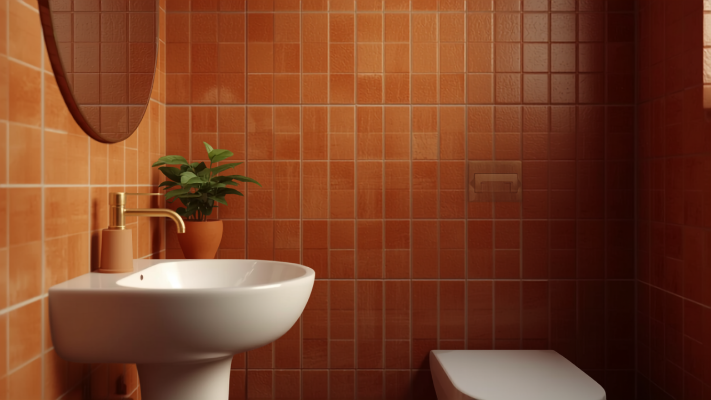
Terracotta is the most versatile of the three because it bridges warm and earthy in a way few other colors do. It’s not quite orange, not quite red, not quite brown — it sits in that beautiful middle space that works in almost any room.
As a wall color: Terracotta walls are having a major moment. In a living room, they create warmth that makes every piece of furniture look better. In a bedroom, they’re cozy and intimate without feeling heavy. Benjamin Moore’s Red Parrot (2090-30) and Farrow & Ball’s Red Earth (No. 64) are both popular choices. If you want something softer, Sherwin-Williams’ Copper Wire (SW 6369) is a dustier, more muted terracotta that feels very 2026.
As accents: If painting your walls terracotta feels like too big a commitment, bring it in through ceramics, throw pillows, or a large area rug. A cluster of terracotta pots in different sizes near a window or fireplace immediately warms up a room. Terracotta-toned velvet cushions on a neutral sofa do the same.
With pattern: Terracotta in a geometric tile pattern — especially in a bathroom, kitchen, or entryway — is one of the strongest design moves available right now. Even a small terracotta tile section (a shower niche, a backsplash, a floor inset) has an outsized visual impact.
Using Chocolate Brown
Dark brown had a rough decade. It got associated with the over-varnished furniture and builder-grade cabinetry of the 2000s and got written off as boring. 2026 is its full rehabilitation.
The key difference between the brown that feels fresh and the brown that feels dated is quality and depth. The dated version is shiny, orange-tinted, and even. The current version is matte, deep chocolate (sometimes almost black-brown), and has visible grain or texture.
In furniture: A chocolate brown leather sofa or armchair is genuinely one of the best purchases you can make in 2026. Full-grain leather in a deep cognac or espresso tone looks better with age, pairs with everything in this palette, and photographs beautifully. It’s also more durable than most upholstered alternatives.
In wood tones: Darker wood tones — walnut, wenge, ebony-stained oak — are having a strong year after a long run of light scandinavian blonde woods. If you’re buying new furniture or replacing shelving, consider going darker. The depth reads as more sophisticated and works especially well against both terracotta and dark green.
On walls and cabinetry: This is the most dramatic move, and it’s genuinely stunning when done right. Chocolate brown kitchen cabinets (upper and lower, or just lower paired with a lighter upper) look extraordinary. A dark brown accent wall in a dining room or home office has a moody, enveloping quality that feels intentional and expensive. Try Behr’s Sable Smoke (N170-7) or Benjamin Moore’s Black Sable (2124-10).
Using Dark Green
Dark green has been trending for a couple of years and it shows no signs of stopping. The specific dark green that designers love right now sits somewhere between forest and hunter — not quite as cold as classic British racing green, not as warm as sage. It has depth.
The “everywhere” approach: Dark green in high-impact applications — doors, kitchen islands, cabinets, bathtubs, even ceilings — is a maximalist-leaning choice that works extraordinarily well. A dark green kitchen island surrounded by lighter cabinetry is one of the most popular looks coming out of kitchen renovations right now.
As a plant-adjacent color: Dark green walls work especially well in rooms with real plants. There’s something almost optical about it — the walls recede, the plants pop, and the room feels like a living space rather than a decorated one. Floor-to-ceiling bookshelves painted dark green (Benjamin Moore’s Salamander or Farrow & Ball’s Minster Green) look stunning with warm wood-toned books and objects in front.
Paired with natural materials: Dark green gets more interesting when it’s next to something warm and textured. Dark green tile with a warm wood vanity. Dark green velvet cushions on a rattan chair. Dark green walls with terracotta accessories and chocolate leather furniture. The combinations practically design themselves.
Combining All Three in One Room
If you want to use all three colors together, the key is assigning roles: one dominant, one secondary, one accent.
A working example for a living room:
– Dominant: Warm white or linen walls (keep the base neutral so the palette has room to breathe)
– Secondary: Chocolate brown leather sofa — the largest piece of furniture anchors the warmth
– Secondary: Dark green throw blanket, green-toned art, or a dark green side chair
– Accent: Terracotta in the accessories — a large terracotta vase, rust-toned cushions, a terracotta-toned area rug with pattern
Or push it further:
– Dominant: Terracotta walls
– Secondary: Chocolate walnut furniture
– Accent: Dark green plants and a single green upholstered chair
Both approaches work. What doesn’t work is applying all three at equal intensity with no hierarchy — that tends to feel chaotic rather than layered.
What to Pair With Them
A few additions that make this palette sing:
Warm brass or bronze hardware. Gold-tone metals — aged brass, unlacquered brass, oil-rubbed bronze — tie into the warmth of all three colors and elevate the overall look.
Cream and off-white. Pure white can feel jarring against these deep, warm colors. Use creamy whites, warm linens, and antique ivory instead for a more cohesive feel.
Natural textures. Terracotta, brown, and green all pair naturally with jute, rattan, linen, leather, and raw wood. Lean into these materials and the palette becomes even more cohesive.
Black as an anchor. Small amounts of matte black — in a lamp base, a picture frame, a curtain rod — add crispness without fighting the warmth.
A Room That Gets It Right
Picture this: a sitting room with deep terracotta walls, a pair of dark walnut side tables, a boucle cream sofa layered with chocolate leather cushions and a chunky dark green throw, a terracotta-glazed lamp, a fiddle leaf fig in a raw terracotta pot, brass picture rail hardware, and a woven jute rug.
Every element reinforces the others. The room feels unified, warm, and like someone made real decisions. That’s what a palette does when you commit to it.
Earth tones aren’t safe. Done right, they’re the most interesting rooms in the house.