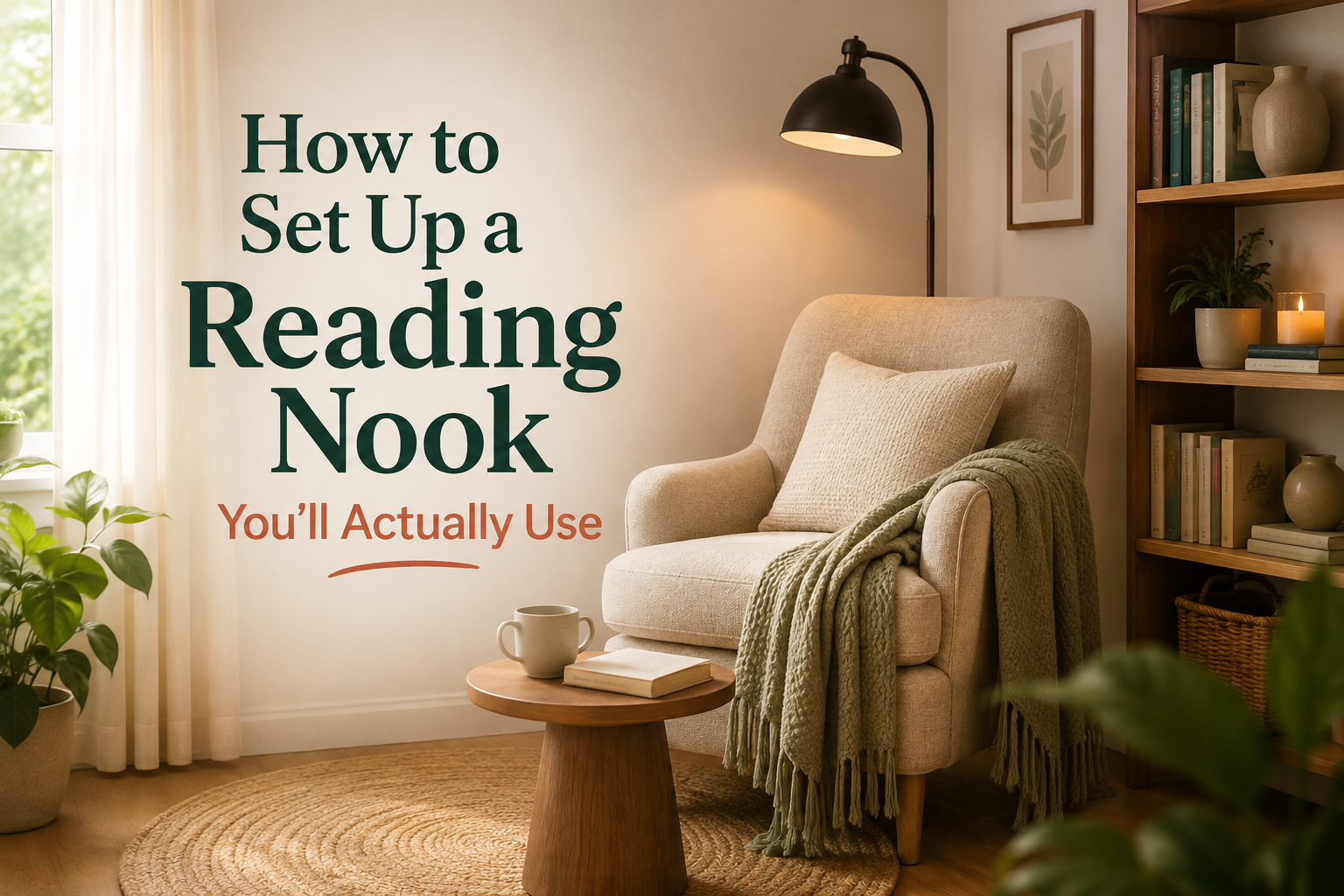
Designing a functional reading nook requires prioritizing proper lighting, comfort, and accessibility over pure aesthetics. Suitable locations offer soft natural light or layered artificial lighting. Seating should match personal reading habits, while a nearby side table or shelf provides essential storage for drinks and books.
Task lighting should use warm-toned bulbs positioned at shoulder height to minimize eye strain. Keeping a small, regularly rotated selection of current books within arm’s reach prevents clutter. Addressing practical factors like drafts and seating support creates a comfortable space suitable for extended reading sessions.
Everyone wants a reading nook. Almost nobody actually uses the one they build. You’ve probably seen the version that goes wrong: a beautiful chair positioned under a window that gets direct glare in the afternoon, a stack of books nobody’s opened in months, and the chair itself gets used as a place to throw a jacket instead. A reading nook that actually gets used isn’t about the prettiest chair you can find. It’s about solving for light, comfort, and proximity, in that order, and then decorating on top of a setup that already works.
What You’ll Achieve
By the end of this, you’ll have a specific spot in your home — even if it’s just a corner of a bedroom or an unused stretch of hallway — that’s genuinely comfortable enough to sit in for an hour, lit well enough to read in without eye strain during the day or at night, and stocked with what you actually need close at hand. That last part matters more than people think. A reading nook you have to get up from three times in the first ten minutes isn’t a reading nook, it’s just a chair.
Step 1: Pick the Spot Based on Light, Not Looks
Start with natural light first. A spot near a window that gets soft, indirect light for most of the day is ideal — north-facing windows tend to give the most even light without harsh glare. If your only option is a window that gets direct afternoon sun, plan to add a sheer curtain rather than skipping the spot entirely, since direct sun makes pages hard to read and fades book covers and upholstery over time.
If you don’t have a great window option, don’t force it. An interior corner with strong artificial lighting works just as well, and honestly holds up better for evening reading anyway. Our piece on common lighting mistakes covers why so many reading spots end up under-lit in the first place — usually it’s a single overhead fixture doing a job it was never built for.
Step 2: Choose Seating Based on How You Actually Read
Think honestly about your habits before you buy a chair. Do you curl your legs up under you, or sit upright with your feet on the floor? Do you read for twenty minutes or two hours at a stretch? A deep armchair with a slight recline works well for long sessions and curled-up posture. A firmer chair with good back support suits shorter sessions or anyone who reads sitting upright with a notebook nearby.
Whatever you choose, add a small side table or a stool you can use as one. This is the step people skip most often, and it’s the reason so many reading nooks fail — there’s nowhere to put down a mug, a phone, or the book itself when you need both hands free for a second. If space is tight, a narrow shelf mounted at arm height does the same job without taking up floor space; our guide to wall shelf styling has ideas for exactly this kind of narrow, functional shelving.
Step 3: Layer the Lighting Properly
One lamp is rarely enough, and overhead light alone is almost always too harsh and too far from the page. The setup that actually works is a dedicated reading lamp positioned at shoulder height when you’re seated, angled so the light falls on the page rather than in your eyes, paired with a softer secondary light source in the room for ambiance once the sun goes down.
A warm-toned bulb, somewhere around 2700K, is far more comfortable for long reading sessions than a cool white bulb, which tends to feel closer to office lighting than something you’d want to relax under. If you’re building this nook in or near a bedroom, our breakdown of mood lighting has good options for lamps that do double duty as both task lighting and ambient light once you close the book for the night. And if you’ve never really thought about layering light sources before, our simple lighting fixes guide breaks down the basics in a way that applies well beyond just this one corner of the house.
Step 4: Add Storage Within Arm’s Reach
The books you’re actually reading right now — not your whole collection — should live within arm’s reach of the chair. A small side table with a shelf underneath, a floor-standing magazine rack, or even a simple basket on the floor next to the chair all work. The goal is that picking up where you left off doesn’t require walking to another room.
Keep this collection small and rotate it. A nook that accumulates twenty unread books starts to feel like clutter rather than an invitation, and that’s often when people stop using the space altogether. Swap the stack out every month or two, keeping only what you’re actually mid-way through plus one or two you’re genuinely planning to start next.
A quick note on temperature and drafts, since it’s easy to overlook: a spot right next to a window or exterior wall can run noticeably colder in winter, which is enough to shorten how long anyone wants to sit there. If that’s your only option, a floor rug underfoot and a throw blanket draped over the chair arm solve most of the problem without requiring any structural changes to the room.
Common Mistakes to Avoid
The biggest one is choosing a chair for how it photographs rather than how it feels after twenty minutes of sitting in it. Sit in it for real before you commit, ideally with a book in hand. The second most common mistake is skipping a side table because the space feels too tight — a slim 12-inch table or a wall-mounted shelf almost always fits somewhere, and going without one is the fastest way to abandon the whole setup.
The third mistake is over-decorating before the function is solid. A beautiful throw blanket and a curated stack of books won’t fix a nook that’s poorly lit or physically uncomfortable. Get the light and the seating right first. Everything else is easy to layer on once the bones actually work.