

Feng shui gets a bad rap in a lot of decorating circles. People hear the word and picture bagua maps, compass directions, and rules so specific they’d need a consultant just to move a lamp. But strip away the mysticism and the core idea is pretty simple: your bedroom’s layout affects how you feel in it, and small, deliberate changes to that layout can make the room feel calmer, more restful, and less chaotic. You don’t need to believe in chi flowing through your walls to notice that a bedroom with a clear path to the door and a bed that isn’t crammed into a corner just feels better to be in.
This guide covers what feng shui means for a bedroom, the handful of principles that matter most, and how to apply them without turning your room into a shrine to a philosophy you’re not fully sold on.
What Feng Shui Is
Feng shui is a centuries-old Chinese practice concerned with arranging physical space to support the flow of energy, or “chi,” through a room. In a home decor context, most of what people mean by “feng shui your bedroom” boils down to placement: where the bed sits relative to the door, what’s visible when you lie down, how much clutter is in the room, and whether the space feels balanced or lopsided.
If this sounds familiar, it’s because a lot of cultures have some version of this idea. In India, Vastu Shastra covers similar territory, with its own rules about room orientation and placement. If you’ve looked into Vastu-friendly plants for the home, you’ve already brushed up against this same underlying instinct: that where you put things in a room isn’t neutral, it changes how the space feels to live in.
Why People Love It
The honest answer is that a lot of feng shui advice is just good design sense dressed up in older language. Don’t sleep facing a door directly. Don’t clutter the space under your bed. Keep a clear walking path. None of that requires a belief in energy fields to be useful, it’s just how humans respond to a room. A bed tucked into a corner with no clear sightline to the door triggers a low-level unease most people can feel even if they can’t name it. Fix the layout, and the unease goes away, whether you credit chi or basic spatial psychology.
There’s also something appealing about having a framework at all. Decorating a bedroom from a blank slate is hard, and feng shui gives you a starting checklist instead of an overwhelming blank page. That’s a big part of why it’s stuck around this long.
The Core Principles
The commanding position. This is the single most repeated feng shui rule, and it’s the one worth prioritizing if you only take one thing from this guide. Your bed should be placed so you can see the door from where you lie, without being directly in line with it, and ideally with a solid wall behind the headboard rather than a window. This isn’t about superstition so much as basic comfort: you can see who’s coming in, and you’ve got something solid at your back.
No bed under a window. Practically, this is about drafts and light control, but it also just tends to feel less stable. A solid wall behind the headboard reads as more restful than glass.
Clear the space under the bed. Storage boxes crammed under the bed frame are one of the most common feng shui “violations,” and honestly, it’s just clutter logic. Stuff piled where you sleep, even out of sight, tends to correlate with a room that never quite feels settled.
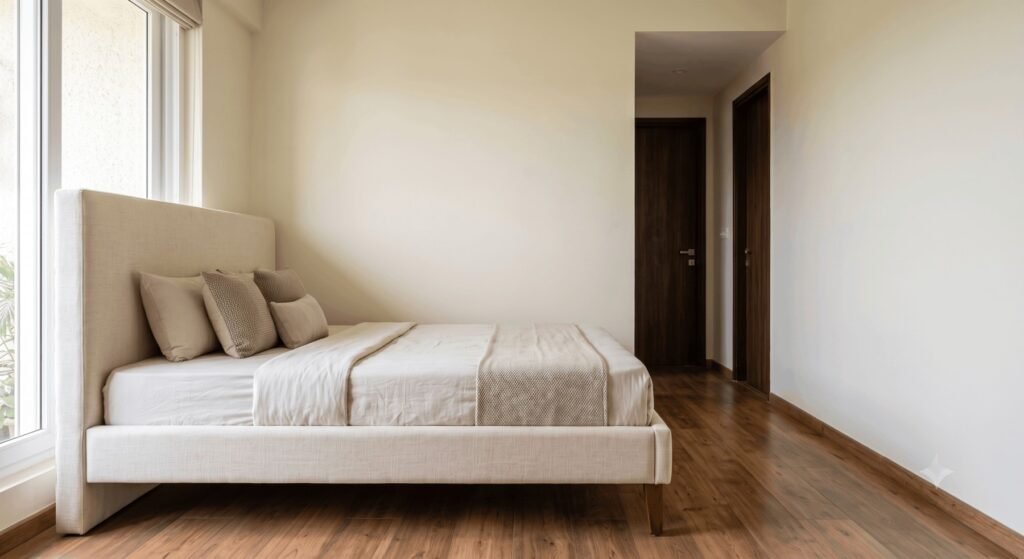
Balance the nightstands. Two matching or at least similarly scaled nightstands, one on each side of the bed, create symmetry that reads as calm. A single nightstand shoved to one side throws the whole room slightly off-kilter, even if you can’t immediately say why.
Soft, warm lighting over harsh overhead light. A bedroom lit entirely by a single bright ceiling fixture doesn’t invite winding down. If your current setup relies on one overhead light and nothing else, it’s worth a look at why bedroom lighting so often fails before you start moving furniture, since lighting does as much work as layout here.
Minimize mirrors facing the bed. The traditional reasoning is about energy reflecting back and forth while you sleep. The practical reasoning is that catching your own reflection when you wake up at 3 a.m. is startling for a lot of people. Either way, angle mirrors elsewhere if you can.
How to Get Started
Don’t try to overhaul the whole room in one afternoon. Start with the bed position, since that’s the principle with the biggest impact. If your headboard is currently against a window or facing the door head-on, that’s fix number one. From there, clear out from under the bed. It’s the fastest, cheapest change on this list and it makes a noticeable difference almost immediately.
Next, look at your nightstands and lighting together, since they work as a pair. If you’ve only got one nightstand, even a small, inexpensive second one restores the balance. Add a lamp on each side rather than relying on an overhead fixture, and dim, warm bulbs will do more for the room’s mood than anything else on this list.
Once the bones are right, layer in the softer stuff: a calming color palette, natural materials, and a general reduction in visual noise. This is also a good moment to take stock of general clutter across the room, more than under the bed. Our guide to organizing a home without it feeling like a chore has practical tactics that apply just as well to a single bedroom as a whole house.
Common Beginner Mistakes
The biggest one is trying to apply every rule at once and getting overwhelmed before anything changes. Pick the commanding position first. Everything else is secondary.
The second mistake is treating feng shui as decor style rather than layout logic. You don’t need specific colors, specific materials, or specific art to “do” feng shui correctly. You can have a completely modern, minimalist bedroom or a maximalist, layered one and still follow the same underlying placement principles. It’s about function first.
The third mistake is ignoring practical constraints in service of the rules. If your room’s architecture doesn’t allow a solid wall behind the bed, don’t stress over it. Do what you reasonably can and move on. A rigidly “correct” layout that makes you anxious about compliance defeats the entire purpose.
Frequently Asked Questions
Does feng shui work, or is it just placebo? Depends who you ask, but functionally, the layout principles map closely onto solid design psychology, so even skeptics tend to notice a difference when they follow them.
Do I need to know my room’s compass direction? Not for the basics covered here. Compass-based feng shui exists and gets much more specific, but the commanding position and clutter principles work regardless of which way your room faces.
What if I can’t move my bed away from the window? Add a substantial headboard or use a curtain to create a visual buffer. It’s not a perfect fix, but it softens the effect.
Is this the same as minimalism? Related, but not identical. Feng shui cares about placement and flow; minimalism cares about quantity of objects. A room can be fairly full and still follow good feng shui principles if the layout is right.
A calmer bedroom doesn’t require a total renovation or a deep dive into ancient philosophy. Get the bed in the right spot, clear what’s underneath it, balance the lighting, and you’ll feel the difference within a few nights, whatever you want to call the reason why.
Related guides
- Kids Room Decor India: Study, Play and Sleep
- Rental Home Decor Ideas India, No Drilling Needed
- Small Entryway Ideas When You Have No Foyer
- Why Your Living Room Feels Off and How to Fix It
Browse bedroom decor to shop the pieces mentioned here.