
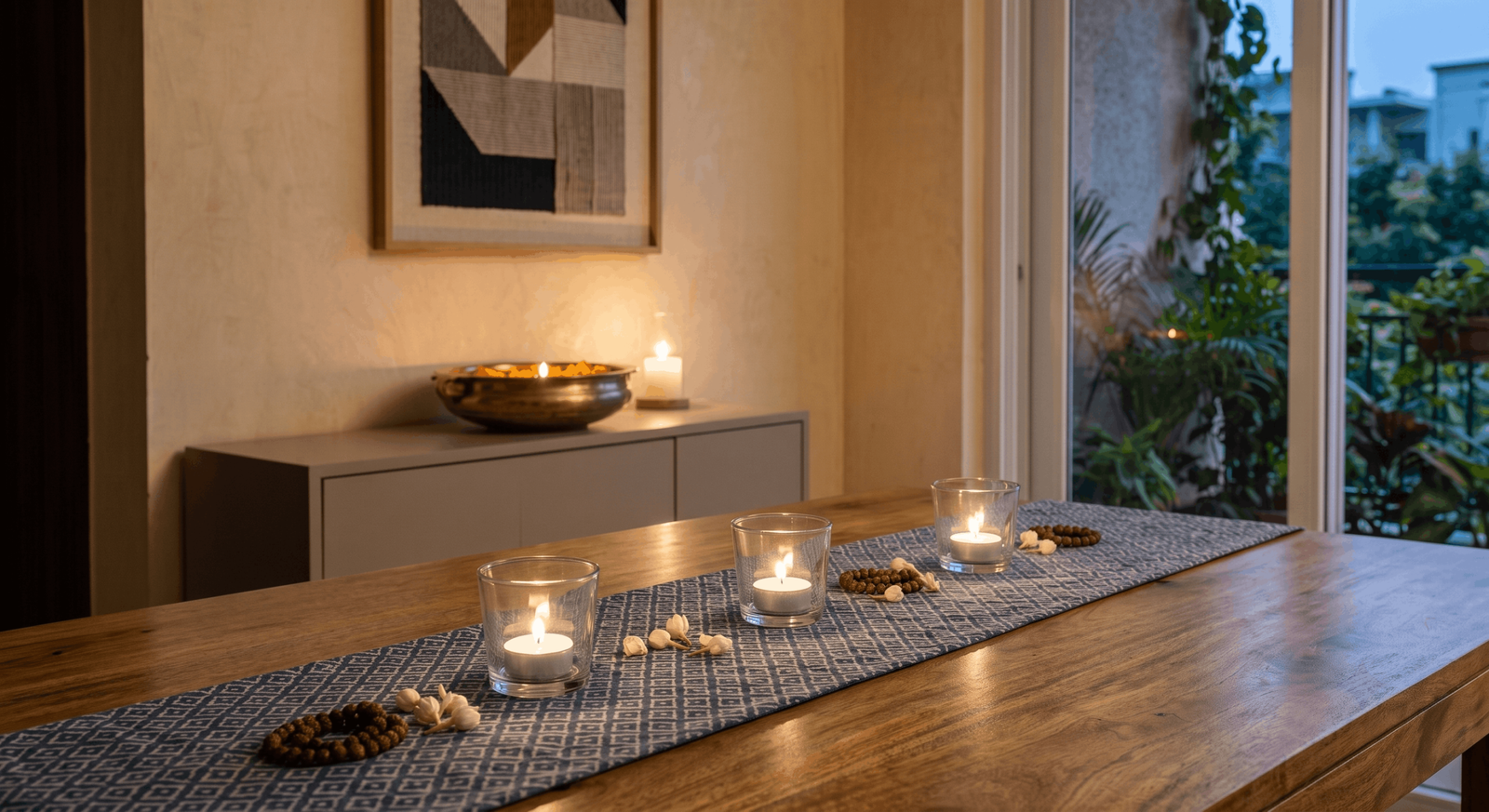
Most dining table centerpieces are trying too hard, and I’ll die on this hill. Walk into any home showroom or scroll any decor account and you’ll see the same thing: an over styled cluster of candles, dried florals, ceramic objects, and books stacked just so, all competing for attention in the exact center of the table. It looks nice for a photo. It looks stressful in real life, because the second you want to eat dinner there, you’re rearranging six objects to make room for a serving dish.
A good centerpiece isn’t a still-life installation. It’s a low-effort, high-impact detail that makes the table feel finished without getting in anyone’s way. Most people get this backwards.
Why Most People Get This Wrong
The instinct is to think “more” equals “more finished.” So people pile on: a runner, a bowl, candles, a vase, maybe a small stack of coasters or books for height variation, all competing for the same six inches of table real estate. The result reads as busy rather than intentional, and worse, it’s impractical. A centerpiece that has to be fully cleared and reassembled every time you use the table for its actual job isn’t a centerpiece, it’s an obstacle.
The other mistake is scale. A centerpiece that’s too tall blocks sightlines across the table, which kills conversation at a dinner party faster than almost anything else. A centerpiece that’s too small looks like an afterthought on a large table, lost in the middle of all that empty wood or glass. Getting the proportions right matters more than any object you choose.
The Right Way to Think About It
Here’s the mental shift that fixes most centerpiece problems: think of it as a low, horizontal gesture, not a vertical display. The best dining table centerpieces read as a single cohesive idea rather than a collection of separate objects vying for attention. That might be a long, low arrangement of greenery in a simple vessel. It might be a cluster of three candle holders at varying but modest heights. It might just be a beautiful bowl of lemons. The common thread is restraint: one idea, executed well, rather than five ideas fighting each other.
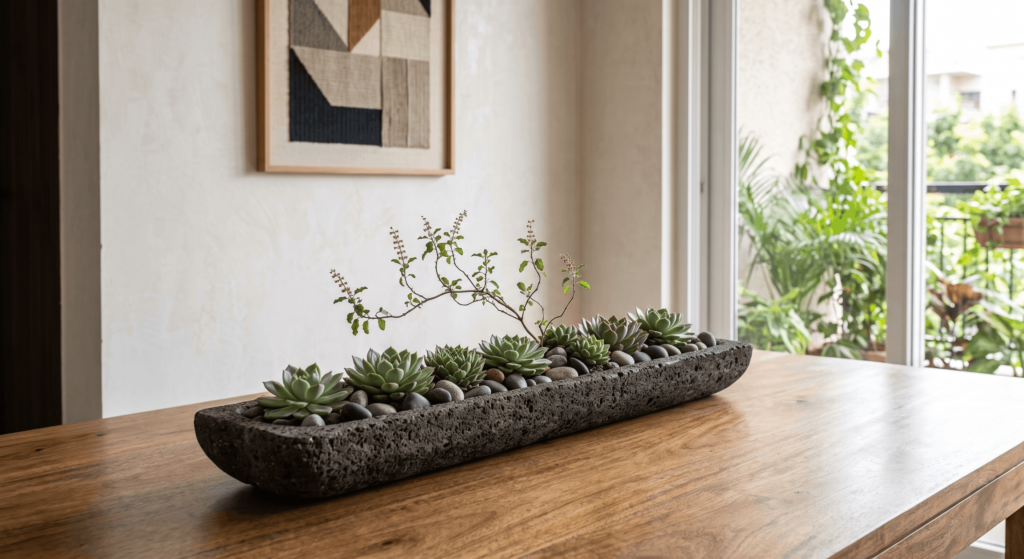
It also helps to think about the centerpiece in relation to how the table gets used. If you eat there daily, you want something that can either stay put through a meal without being in the way, or something fast to move and put back. If the table’s mostly for entertaining, you’ve got more room to be elaborate since it’ll only be up during those occasions.
How to Apply It
Start with a base layer, and keep it simple. A table runner in a natural material like linen or a woven grass fiber does a lot of visual work on its own, especially against a wood table, and it defines the “zone” where the rest of the centerpiece lives without needing anything on top of it yet. If your table is bare wood or a solid color, you can skip the runner and go straight to the next layer, but don’t skip both, or the centerpiece will look like it’s floating with no anchor.
From there, add height in odd numbers. A single tall element (a slim vase, a single dramatic branch) paired with two or three lower elements (candle holders, a small dish, a couple of stones or ceramic objects) creates visual rhythm without clutter. Our table centerpiece category has a good range if you’re starting from scratch, and a set of low candle holders is one of the most flexible investments you can make here, since they work solo or as part of a bigger arrangement.
Greenery and flowers matter more than people give them credit for, and you don’t need a florist’s budget to get this right. A single stem of something interesting in a good vase often beats a full, fussy bouquet. If you’ve got access to a garden or even a balcony with a few plants, our garden decor guide has ideas for cutting and arranging what you’re already growing instead of buying flowers every week.
Keep the color palette tight. Two, maybe three tones, pulled from what’s already in the room, whether that’s the wood of the table, the wall color, or the dining chairs. A centerpiece that introduces four new colors the room hasn’t seen anywhere else will always look a little out of place, no matter how nice the individual pieces are.
What to Avoid
Skip anything fragrant that competes with food. Strongly scented candles are a classic mistake, since a heavily perfumed centerpiece fights with whatever’s being served. Unscented candles or none at all, always.
Avoid anything taller than about fourteen inches unless it’s narrow, like a single tall branch. Anything wider and tall at once blocks the view across the table, and that’s the fastest way to make a beautiful centerpiece annoying to sit near.
Don’t use anything precious or easily knocked over if the table gets regular daily use with kids or pets around. Save the delicate ceramics and glass for the occasions when the table’s being dressed up specifically, and keep the everyday version sturdier and simpler.
And resist the urge to make it permanent and untouchable. A centerpiece that can’t be moved out of the way in ten seconds when you need the table isn’t decor, it’s furniture you now have to work around. The best ones we’ve seen in real homes get shifted constantly, and that’s a feature, not a flaw.
Final Thought
The dining tables that feel the most put-together usually have the least going on at the center of them. One good idea, kept low, kept tight in color, and easy to move when real life needs the space, will always beat a crowded arrangement built for a photo nobody’s going to take on a random Tuesday. Simplify what’s there now, and the table will probably look better within the hour, not after a shopping trip.
Related guides
- Grandmillennial Style: How to Decorate With Pattern
- Gallery Wall Layout: How to Arrange Frames
- Rug Size Guide: How to Choose for Every Room
- How to Mix Patterns Without It Looking Like a Mess
Browse table centrepieces to shop the pieces mentioned here.