
Quick answer: Housewarming gifts get kept in Indian homes when they pass three tests: the household will use them weekly, they fit any decor style, and a duplicate would still be useless to pass on. Plants in good ceramic pots, woven storage baskets, serving trays, and consumable candles pass. Showpieces, the fourth dinner set, and anything left in its seller packaging enter the regift cycle, usually by the next Diwali.
Every Indian family has a regift shelf. Nobody calls it that. It is the top of the almirah, or the box under the guest bed, where gifts wait in their original packaging for the next wedding, griha pravesh, or office Secret Santa. Some boxes of soan papdi are believed to have been circulating since 2011.
Here is the uncomfortable part: the regift shelf is not rude. It is a rational response to gifts that failed three simple tests. If you want your housewarming gift to escape the shelf, run it through the tests before you buy.
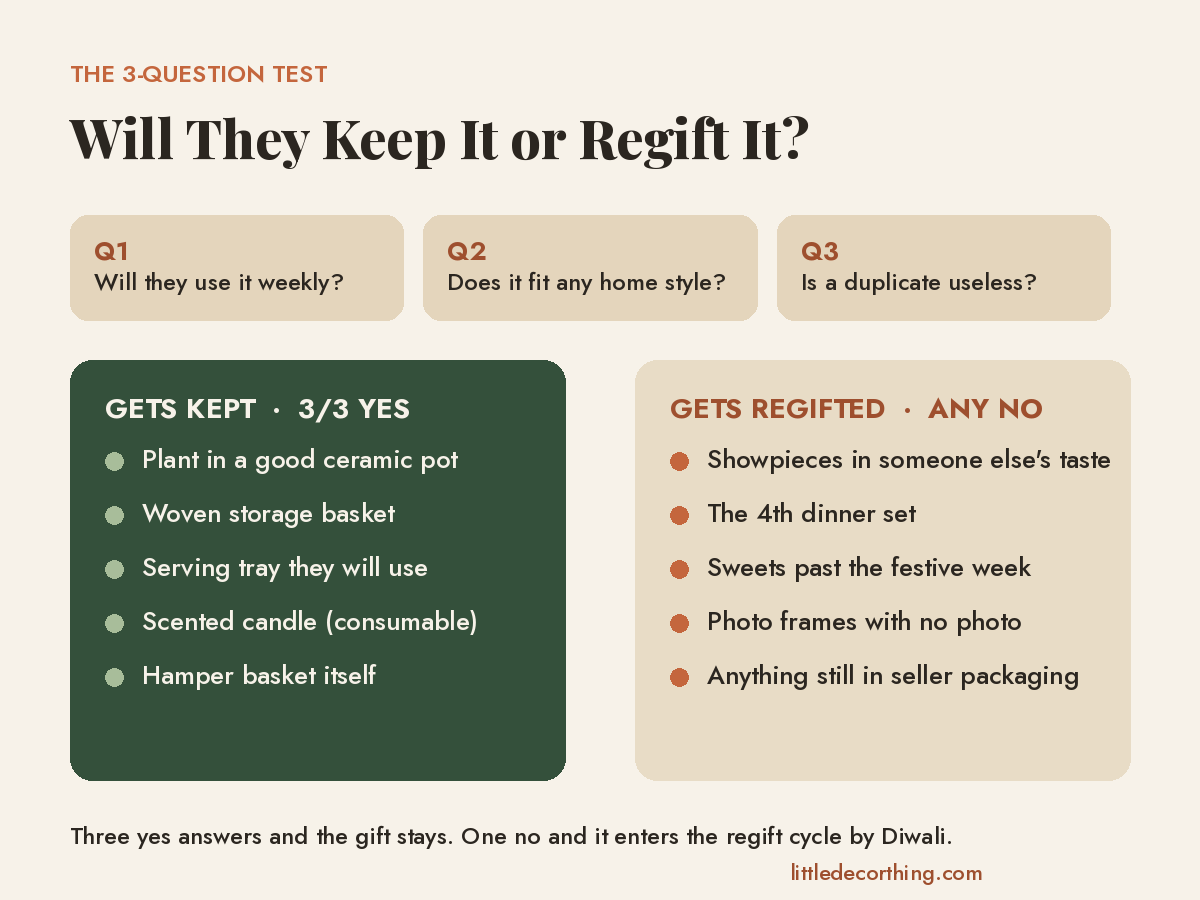
The 3-question test
Q1: Will they use it weekly? A serving tray gets used every time guests come. A decorative crystal swan gets dusted. Usage builds attachment, and attachment is what keeps a gift out of the almirah.
Q2: Does it fit any home style? You do not know their decor plans. A neutral woven basket fits a minimal flat, a traditional home, and everything between. A bright purple wall clock fits one specific home that probably is not theirs.
Q3: Is a duplicate still useless to regift? This is the sneaky one. Dinner sets fail it spectacularly, because every griha pravesh produces three of them, and the spares regift perfectly in their sealed boxes. A planted pot fails to regift even in theory. You cannot rewrap a living thing with soil in it, so it stays.
Three yes answers and the gift stays. One no, and you have bought future inventory for someone else’s gifting calendar.
What gets kept, and why
- A plant in a good ceramic pot. Alive, useful, impossible to regift, and it physically grows alongside their new home. A money plant in a ceramic log planter (₹320) costs under ₹500 total and sits at their entrance for years. Total cost of the average regifted dinner set: more.
- A woven storage basket. New homes are unpacking chaos for months. A woven cotton basket (₹599) gets drafted into toy duty or laundry duty within a week of arriving, which is the fastest route to permanent residence.
- A serving tray. Used every single time chai is served to a guest, which in a new Indian home is constantly for the first six months.
- Scented candles. Consumables cheat the test, because using them up is the point. Nobody regifts a half-burnt candle.
- The hamper basket itself. If you gift a hamper, the basket keeps working long after the contents are gone. This is the strongest argument for hampers over boxed gifts.
What gets regifted, and why
- Showpieces in your taste, not theirs. The crystal swan, the dancing couple figurine, the giant decorative spoon. Taste-specific decor fails Q2 the moment it leaves your hands.
- The fourth dinner set. Fails Q3. Everyone gifts dinner sets to new homes, and the duplicates circulate sealed.
- Sweets, after the festive week. Lovely for three days, then the box joins the shelf with its expiry date doing a countdown.
- Photo frames with no photo. A frame is a task disguised as a gift. The household now owes the frame a printed photograph, and most frames die waiting.
- Anything still in seller packaging. If the gift can be re-wrapped without anyone knowing, eventually it will be.
Seven gifts that pass, by budget
| Gift | Budget | Why it stays |
|---|---|---|
| Money plant in a ceramic pot. | Under ₹500 | Alive, entrance-worthy, cannot be rewrapped. |
| Set of small ceramic planters with succulents. | Under ₹700 | Spreads across windowsills within a week. |
| Woven cotton storage basket. | Under ₹600 | Drafted into daily duty during unpacking. |
| Lined jute basket with leather handles. | Under ₹800 | The premium look, holds blankets by the sofa. |
| Built hamper: basket, plant, candle. | Under ₹1,500 | Three keepers in one, see our hamper guide. |
| Brass or ceramic serving tray. | Under ₹1,000 | Weekly guest duty from day one. |
| Good scented candles, set of two. | Under ₹800 | Consumed, remembered, repurchased. |
One honest note on idols and religious gifts
Idols are gifted with real warmth at griha pravesh, and received with equal warmth. They are also deeply personal. The deity, the size, the material, and the placement all carry meaning that varies family to family, and many households already have their pooja arrangement planned before the boxes are unpacked. If you know the family’s tradition well, an idol can be the most treasured gift in the house. If you are guessing, a plant guesses better.
Frequently asked questions
What is the best housewarming gift in India under ₹500?
A money plant in a glazed ceramic pot. It costs under ₹500 assembled, suits every decor style, gets placed at the entrance where good-luck plants traditionally go, and cannot enter the regift cycle.
What gifts should I avoid for a griha pravesh?
Dinner sets (the household will receive several), taste-specific showpieces, empty photo frames, and large sweet boxes beyond what the family can finish in a week. Each one fails at least one of the three keep-tests.
Are plants a good housewarming gift?
Among the best. They pass all three keep-tests, carry the growth-in-a-new-home symbolism Indian families value, and the pot remains as decor even if the plant is eventually replaced.
Is cash or a gift better for housewarming in India?
The shagun envelope is always correct and always appreciated. A small keeper gift alongside it, like a planted pot, adds the personal layer cash cannot, and the combination covers both traditions.
How much should I spend on a housewarming gift?
₹500 to ₹1,500 covers every keeper on this list. Past ₹1,500 you are paying for size, not for the gift’s odds of being kept, which depend on the three tests rather than the bill.
Related guides
- Vastu Plants for Home: What to Keep and Where
- Diwali Home Decoration Ideas 2026, Room by Room
- Home Organisation Ideas for Indian Flats
- Janmashtami Decoration Ideas for Home
Browse housewarming gifts to shop the pieces mentioned here.