
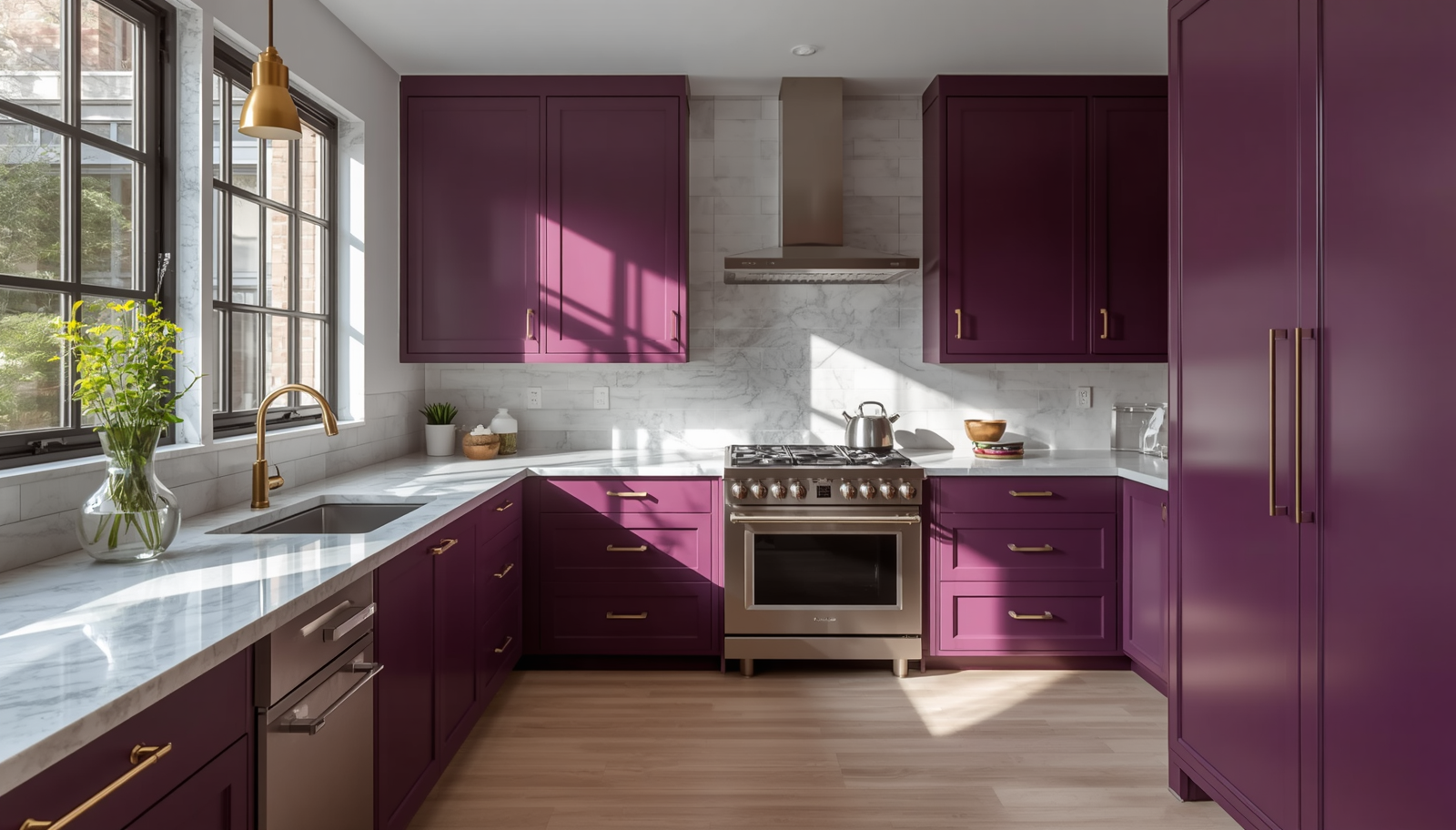
White kitchen cabinets had a good run. They were clean, they were safe, they photographed well. But heading into 2026, the design world is done with them, and the colored cabinets taking their place are striking.
Why Everyone Is Finally Ditching White Cabinets
Here’s what happened: white kitchens became so ubiquitous that they stopped feeling like a design choice. They became a default. Walk into any home staged for sale in the past decade and you’d see the same thing, white shaker cabinets, subway tile backsplash, stainless steel appliances. Safe. Predictable. Instantly forgettable.
Meanwhile, a growing number of homeowners started craving something with more personality. Something that felt like it belonged to them specifically, not to every house on the market.
Enter moody, colored, expressive kitchen cabinets. According to House Digest and Homes & Gardens, searches for colored cabinet ideas have surged dramatically, with specific shades like aubergine (a deep purple-brown), forest green, navy, and warm clay all gaining serious traction in 2026. Pinterest reported that searches for “grandma core kitchen” and “dark cottagecore kitchen” jumped by hundreds of percent year over year, which tells you people aren’t just dabbling in color, they’re going all-in on personality.
Interior designer Erin Coren described it simply: “Where white kitchens were the rage for the past decade, moody, rich colors are now making their way through the home.”
The Colors That Are Trending Right Now
Not all colored cabinets are created equal. Here’s what’s resonating in 2026 specifically:
Aubergine. This is the color getting the most attention this year. Deep, rich, and slightly mysterious, aubergine sits somewhere between eggplant purple and dark brown, it photographs beautifully and reads as sophisticated. If you want drama, this is your color. Pair it with unlacquered brass hardware for a look that feels both old-world and current.
Forest and sage greens. Green has been a slow burn for a few years now and it’s fully arrived. Forest green cabinets feel grounded and organic. Sage green is lighter and airier, better for kitchens that don’t get much natural light. Both pair beautifully with warm wood accents and cream or linen countertops.
Warm navy. Not the bright cobalt blue of a few years ago, but a deeper, slightly grayer navy, think ink rather than sky. This color reads as almost neutral in a kitchen and works with nearly any countertop material.
Deep clay and terracotta. These warm, earthy tones are very much part of the broader 2026 color movement across home decor. Clay cabinets are unexpected but immediately feel warm and inviting. They work especially well in Mediterranean or earthy-modern kitchen aesthetics.
Muted charcoal. For people who want something darker and more dramatic than white without fully committing to a jewel tone, warm charcoal is an excellent middle ground. It reads as a warm black from a distance but has more nuance up close.
Browse our Kitchen Decor section for hardware and accessories that complement these cabinet colors.
How to Pull Off Colored Cabinets Without Regretting It
Choosing a bold cabinet color is exciting but it requires some thought about how everything else in the kitchen will work with it. Here’s how to do it right:
Treat your countertop as the neutral. If your cabinets are the statement, your countertops should recede. White or cream quartz, light marble, or warm wood butcher block all let bold cabinets breathe. Avoid trying to match cabinet and countertop colors, that coordination tends to feel overdone.
Choose hardware carefully. Hardware is small in scale but disproportionately important in impact. Unlacquered brass or aged brass reads warmly against moody cabinet colors and has an artisanal feel. Matte black is more dramatic and contemporary. Brushed nickel tends to look too generic with bold cabinets, it’s designed for neutral kitchens.
Consider what you’re NOT painting. In kitchens with both upper and lower cabinets, painting everything the same bold color can feel heavy. Many designers recommend painting only the lower cabinets in a statement color and keeping upper cabinets white or a lighter neutral. This grounds the color and keeps the room from feeling closed in.
Get large paint samples first. This is non-negotiable. A color that looks beautiful on a tiny chip will look completely different when it covers 80 square feet of cabinetry. Most paint companies sell large sample pots, paint a full door and a drawer front and live with it for several days across different lighting conditions before committing.
Think about your appliances. Stainless steel works with most colored cabinets. Matte black or panel-ready appliances can look particularly sophisticated with moody colors. White appliances can feel out of place with very saturated cabinet colors, just something to factor in.
The DIY Route: Can You Paint Your Own Cabinets?
Yes, but with realistic expectations. Painting kitchen cabinets yourself is a project that takes a full weekend (at minimum) and involves more prep work than most people anticipate. Done well, it looks fantastic. Done carelessly, it shows every brush stroke and starts chipping within months.
The honest breakdown:
Prep is 70% of the job. You need to degrease the cabinet surfaces thoroughly (TSP solution or a quality degreaser), sand to create tooth for the paint to grip, and prime with a bonding primer specifically designed for slick surfaces. Skipping or rushing any of these steps is how you get peeling paint in six months.
Use the right paint. Not regular wall paint. You want a cabinet-specific formula or a high-quality enamel that’s formulated to cure hard and resist moisture and daily wear. Benjamin Moore Advance, Sherwin-Williams Emerald Urethane Trim Enamel, and Behr Alkyd Semi-Gloss are all well-regarded options in the $60, $80 per gallon range. Worth every penny.
Use a foam roller for flat surfaces, a brush for detail. A 4-inch foam roller gives you smooth, streak-free coverage on flat cabinet fronts. Use a small brush for the inside edges and any raised-panel details. Multiple thin coats beat one thick coat every time.
Let it cure fully. Water-based cabinet paints feel dry to the touch in an hour but take 2 to 4 weeks to fully cure and harden. During that time, be gentle, don’t slam doors, don’t scrub, and avoid stacking things against painted surfaces.
If you’re not confident about any part of this, hiring a professional cabinet painter is a legitimate option. A pro will charge $2,000, $5,000 for an average kitchen depending on your location and cabinet count, but the result will last longer and look more polished than a rushed DIY job.
Styling Around Your New Colored Cabinets
Once your cabinets are painted, the styling work begins. A few things that reliably lift a colored kitchen:
Open shelving with carefully arranged objects. A few open shelves against a wall in a complementary color, or left as natural wood, let you display ceramics, glassware, and decor that reinforces your color story. Keep it intentional, not cluttered.
Interesting backsplash choices. Subway tile is almost too expected now with colored cabinets. Consider zellige tiles (handmade Moroccan clay tiles with slight variations in color and texture), large-format stone-look tiles, or unlacquered bronze or brass-finish tiles. With bold cabinets, you have permission to be bold elsewhere too.
Bring in plants and natural elements. Herbs in terracotta pots, a small trailing plant on an open shelf, a wooden cutting board displayed vertically, these organic touches prevent a moody kitchen from feeling cold or overly styled.
Check out our Kitchen Accessories page for curated picks to complete your refreshed kitchen. Also see our Kitchen Decor and DIY Decorating Tips sections.
Is This Trend Here to Stay?
The short answer is yes, because colored cabinets aren’t a trend, they’re a return to common sense. Kitchens had personality and individuality for most of the 20th century. The all-white-everything era was the anomaly.
What might shift is which specific colors are most popular. Aubergine might give way to something else in a few years. But the fundamental idea, that your kitchen can and should reflect your personal taste rather than real estate convention, is firmly here.
If you’ve been staring at your builder-white cabinets and feeling nothing, this is your sign. Pick a color that excites you and make the change.
Related guides
- Home Organisation Ideas for Indian Flats
- How to Mix Patterns Without It Looking Like a Mess
- How to Style a Bookshelf, Shelf by Shelf
- 15 Jute Basket Uses for an Indian Home
Browse kitchen decor to shop the pieces mentioned here.