
You’ve put furniture in there. You’ve got a sofa, a rug, a coffee table. Maybe some cushions, maybe a plant, maybe art on the walls. And still the room feels wrong. Awkward. Like it’s not quite finished, or not quite yours.
This is one of the most common feelings people have about their homes, and it almost never has a single cause. It’s usually a combination of three or four quiet problems that compound into a general sense of discomfort. The good news is that each one has a fix, and most of them don’t require new furniture.
Problem 1: Your Sofa Is Against the Wall
This one is deeply counterintuitive, especially if you grew up in a home where all the furniture was pushed back to create a clear path down the middle. It feels logical, more floor space, more room to move. But in practice, furniture against every wall makes a room feel like a waiting room.
Pull the sofa away from the wall. Even 30 to 45 cm is enough to completely change how the room feels. What you’re doing is creating depth, a visible gap between furniture and wall that the eye reads as intentional space rather than empty waiting room.
Then, instead of having all furniture face each other across a vast expanse of rug, angle the armchairs slightly toward the sofa. Create a loose U or L shape. Now the furniture is in conversation with itself, and the room has a centre of gravity.
The biggest fear with pulling furniture off the wall is that the room will feel smaller. In reality, it feels larger, because there’s visual breathing room and the eye can move around the space rather than getting stuck on furniture blocks against every wall.
Problem 2: The Lighting Is All Overhead
This is probably the single most under-appreciated decorating problem. A room that relies entirely on a ceiling light for illumination is a room that will never feel warm or inviting, no matter what else you do.
Overhead lighting lights the tops of heads and the floor. It creates harsh shadows on faces and flat, dead light on surfaces. It’s functional and necessary, but it should almost never be the only light source in a living room.
The fix is layering. Aim for at least three light sources at different heights:
Floor lamps cast upward light that bounces off ceilings and fills the room with soft, ambient glow. One next to the sofa or in a corner transforms the room from functional to cosy.
Table lamps at eye level when seated create pools of warm light that make the room feel like it has zones and depth. Put one on a side table next to the sofa, one on a console against the wall.
Candles or low accent lighting near the floor or on coffee table level add warmth and intimacy when the main lights are dimmed. They don’t need to be lit to read as intentional, unlit candles in good holders still contribute texture and cosiness.
Switch everything to warm-toned bulbs if you haven’t already, 2700K to 3000K colour temperature. Cool white light is for offices and bathrooms, not living rooms.
Our lighting fixes guide covers specific solutions for common lighting problems, and if you’re looking for mood lighting products that work across rooms, that’s a good place to start.
Problem 3: There’s No Focal Point
Every room needs one thing that the eye goes to first. It organises the space. Without it, the eye bounces around with nowhere to land, and the room feels restless.
In many homes, the focal point used to be the fireplace. Now it’s often the TV, which technically works, but a blank black screen when the TV is off creates a visual void that the room has to work around.
If the TV is your focal point, build around it thoughtfully. Frame it with shelving on either side. Add a console or TV unit beneath it with objects that have presence when the screen is dark. Put wall art on either side so the overall composition is larger than the screen itself.
If you want a different focal point, the options are:
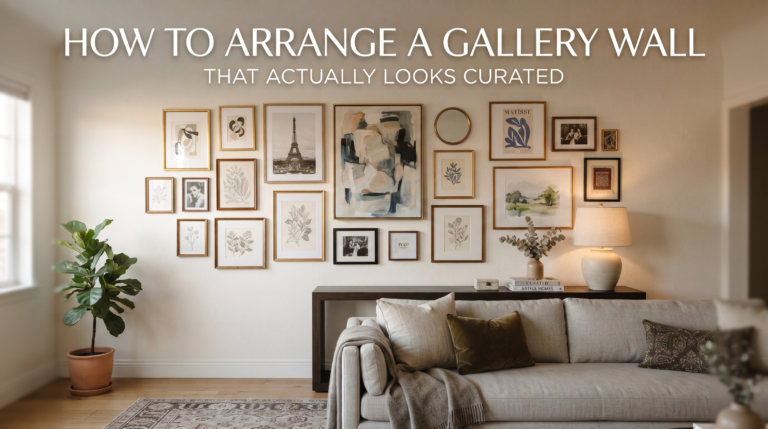
A gallery wall that’s large and confident, not five small frames scattered loosely, but a proper arrangement that takes up real estate and has a clear composition. Our wall hanging art collection has pieces that work well as centrepieces or in gallery arrangements.
A statement piece of furniture, a beautifully upholstered armchair in a strong colour, a dramatic bookcase, a sideboard with real presence.
An architectural feature you emphasise, paint one wall a different colour, add picture rail moulding, create a visual feature where one didn’t exist.
Pick one. The room can only have one focal point. Two compete. Three create chaos.
Problem 4: Your Rug Is Too Small
The rug is doing less work than you think. If it’s sitting in the middle of the seating arrangement with all the furniture legs floating around it, it’s functioning as a floor accent rather than an anchor, and the room is reading it that way.
The fix is almost always: get a bigger rug or reposition the one you have. In a living room, the standard is that the front legs of all the seating, sofa and armchairs, should sit on the rug. This connects the furniture to the rug visually and creates a defined seating zone.
If buying a new rug isn’t in the budget right now, try repositioning the existing one so that at minimum the sofa’s front legs are on it. Even that partial connection is better than furniture floating entirely off the edges.
Problem 5: The Room Has No Visual Layers
A room that feels flat usually has all its furniture and objects at similar heights. The sofa seat height, the coffee table, the TV console, everything is in the same horizontal band. The eye reads this as monotonous.
Building layers means deliberately introducing objects at different heights: something on the floor (a large plant, a stack of books, a sculptural object), something at waist height (console table objects, shelf items), something at eye level (art, mirrors, open shelving), and something that draws the eye up toward the ceiling (a floor lamp, tall bookcase, or even just art hung slightly higher than feels conventional).
Cushions contribute to layering too, different sizes, mixed textures, a throw folded at one end of the sofa. The pile of cushions at varying heights makes the sofa itself feel more textured and composed. Browse our cushions and throws range for combinations that work across different sofa colours.
Problem 6: It Doesn’t Have Anything Personal in It
This is the last thing people think about and often the real reason a room feels wrong. Everything in it is generic. The art could be in anyone’s home. The objects on the coffee table were bought as a set from one store. There’s nothing that tells a story about who lives there.
Personality comes from specificity. A travel souvenir on the shelf. A book you love displayed cover-out. A plant you’ve had long enough to feel invested in. Framed photos, actual printed photos of people you like, in frames you chose deliberately.
None of these things need to be expensive or Instagram-ready. They just need to be yours.
The rooms that stop people in their tracks aren’t necessarily the most expensive or the most perfectly designed. They’re the ones that feel inhabited. Lived in. Like someone made genuine choices about what goes in them and why.
If your room still feels like it’s missing something you can’t name, start there. Add one thing that means something. Then another. That’s usually the fix.
For more inspiration on pulling a living room together, our living room decor shop covers everything from vases to wall art to coffee table pieces, and our home decor blog has plenty of practical guides like this one.
Related guides
- Modern Cottage Style: Cozy Without the Clutter
- Modern Cottage Look Without Starting From Scratch
- Organic Luxe Decor: How to Get the Look at Home
- Rental Home Decor Ideas India, No Drilling Needed
Browse living room decor to shop the pieces mentioned here.